

I gave this presentation to NAVA (North American Vexillological Association) about flag design and the New Zealand flag referendum. It is about a data mining analysis of NZ flag design comments that revealed the previously hidden factors (the “six deal-breakers”) behind whether the public accepts or rejects flag designs. On this page, you can find a YouTube video version and a written article version. I’ve delivered this presentation on two occasions:
- In December 2020, I presented at the Interest Area Meeting where it got a highly positive reception.
- In June 2021, I presented it again at NAVA’s 55th annual conference, where I got an Honorable Mention for the Driver Award.
Video version (NAVA55 presentation)
Article version
Introduction: Beyond Good Flag, Bad Flag
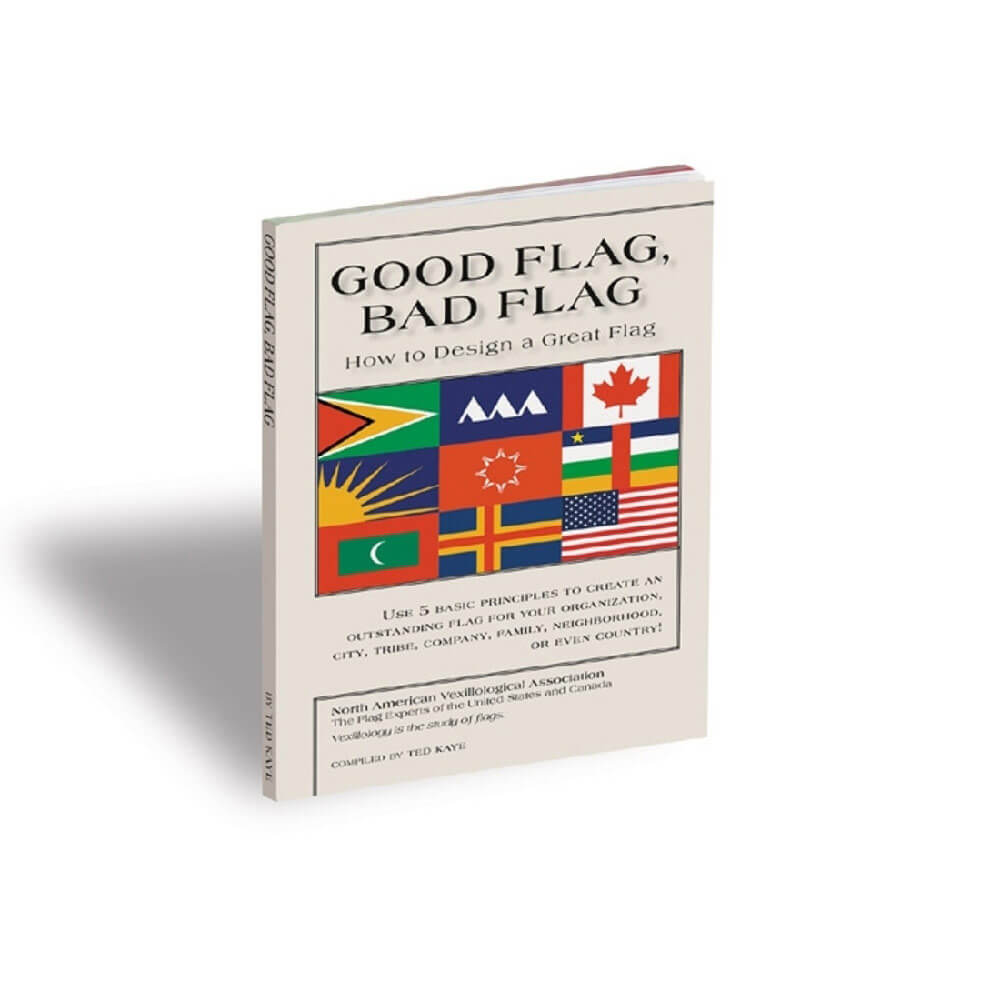
As NAVA members, a lot of us are involved in flag design. We’re either designing flags or we’re evaluating the flag designs of others, so it’s vital for us to know about good flag design. I’ve been passionate about flag design for years and I served on the judging panel for the official flag of NAVA 55 itself. You probably already know about the five principles of good flag design in NAVA’s world-famous booklet Good Flag, Bad Flag: Keep it simple, use meaningful symbolism, use 2-3 basic colours, no lettering or seals and be distinctive or related. This article, based on an Interest Area Meeting presentation I gave in December 2020, goes beyond these basic principles and discusses six little-known deal-breakers of bad flag design.
Methodology

First, let me explain where these deal-breakers come from. Back in 2015, New Zealand had an official competition to redesign its flag and there were about ten thousand designs submitted, each with its own set of public commentary. I and another vexillologist (James Fitzmaurice from the United Kingdom) did an exhaustive survey of the public commentary to help us understand the common factors that were positively and negatively associated with public acceptance. We used a Java web scraper to extract the comments on the government’s website where people could upload design suggestions. We also trawled through all the year’s flag-related articles, social media posts and online comment sections from New Zealand Herald (the nation’s largest newspaper), One News, newshub.co.nz and stuff.co.nz (a current events and opinion site). The first page of search engine results for any informal forums and websites discussing, ranking or voting on design proposals provided our final source of commentary. We treated any opinion as significant if it was topical, clear, specific, sincere and expressed by at least three members of the public independently. In total there were thousands of useful messages but there were many duplicates where many people frequently expressed similar attitudes. These salient quotes were grouped into common and consistent themes which were summarised in Google Docs.
What did we find from the thematic analysis? The majority of useful comments regarded political considerations or particular design elements like colours, layouts and symbols (outside the scope of this article). Some of them just confirmed the basic principles that we already know from Good Flag, Bad Flag. Other comments revealed some lesser known principles that weren’t commonly acknowledged before. These principles are the six deal-breakers of bad flag design. I explained where these came from to point out that these are not just my opinion, these essentially came from the sum of an entire nation’s vexillological commentary across a whole year, so it’s completely in touch with public opinion.
In the end, New Zealand’s official competition and referendum failed. This is partly because the judges were not vexillologists, they were not aware of these deal-breakers and the finalist designs all contained these significant flaws so nobody was satisfied.
The six deal-breakers
Deal-breaker 1: Looks like a logo, not a flag
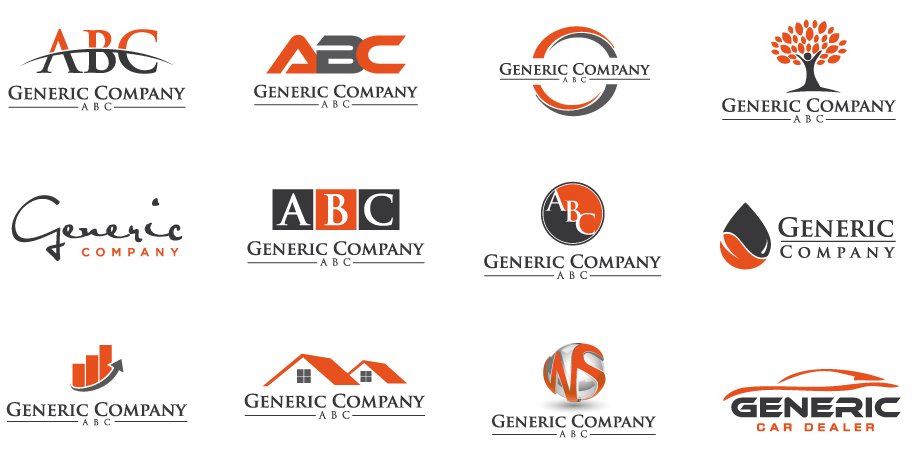
This was by far the most common criticism. There are other variations too. “Looks like a modern art piece, not a flag”. “Looks like corporate branding, not a flag”. “Looks like a website graphic, not a flag”. The point is that doesn’t look like a flag. The public has a stylistic expectation of what a flag looks like, which is a simple, timeless, classic style that fits in well with other flags if you imagine it actually flying on a flagpole and not just a flat image. Sometimes they will compare designs to specific logos but they will reject anything which generally seems ephemeral, flashy and trendy.

This example is actually the main official proposal that went head to head against the national flag and lost. The main criticism is that it looks too much like slick contemporary branding made by a marketing department, rather than a flag that follows classic conventions and standards. In vexillological terms, I think the main issue is that the division of the field is usually a vertical, horizontal or diagonal stripe whereas this design uses the silver fern as both a massive charge and a division of the field at the same time which breaks this unspoken rule. Whatever the reason, the public clearly figured that this looks really off-putting if you imagine it flying on a pole as an actual flag and not just a flat image.
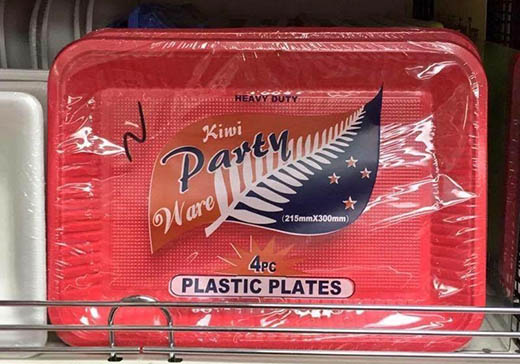
And of course there was the comparison to Kiwi Party Plates.
Deal-breaker 2: Looks like a souvenir, not a flag

This one is similar to the first deal-breaker. Designs can evoke a feeling of cringe and contempt if they look too offbeat, informal or “un-flag-like”. Every designer has to keep in mind that even when symbols and colours are meaningful to a culture, they exist on a spectrum from formal to informal. Relying too much on the informal iconography makes the design seem cheesy or just for tourists.

This example was another official finalist that we got to vote on and it’s literally just the logo of our tourism department put into a rectangle.

This design is also used on the Qualmark logo, which is the tourism department’s official certification scheme so this design is very strongly associated with tourism and souvenirs, which makes the flag look really tacky even if the symbolism is relevant.
Deal-breaker 3: Mystery symbolism

The famous film critic Roger Ebert once declared, “If you have to ask what it symbolizes, it didn’t.” He was talking about film-making but it applies to lots of other areas as well. It’s a problem when designers think of flags as if they’re conceptual art projects and try to invent imagery with lofty ideals which require explanations. It’s a problem even if the explanation has relevance to the location. It just doesn’t work that way because the designer doesn’t have the luxury of explaining the symbolism to every single person and they shouldn’t need it either. Instead of conceptual art, flag design is more like advertising, which is forced to use the shared visual language already existing in a society to intuitively resonate with the audience at first glance. It’s not enough for symbolism to be meaningful, it also has to be recognisable.
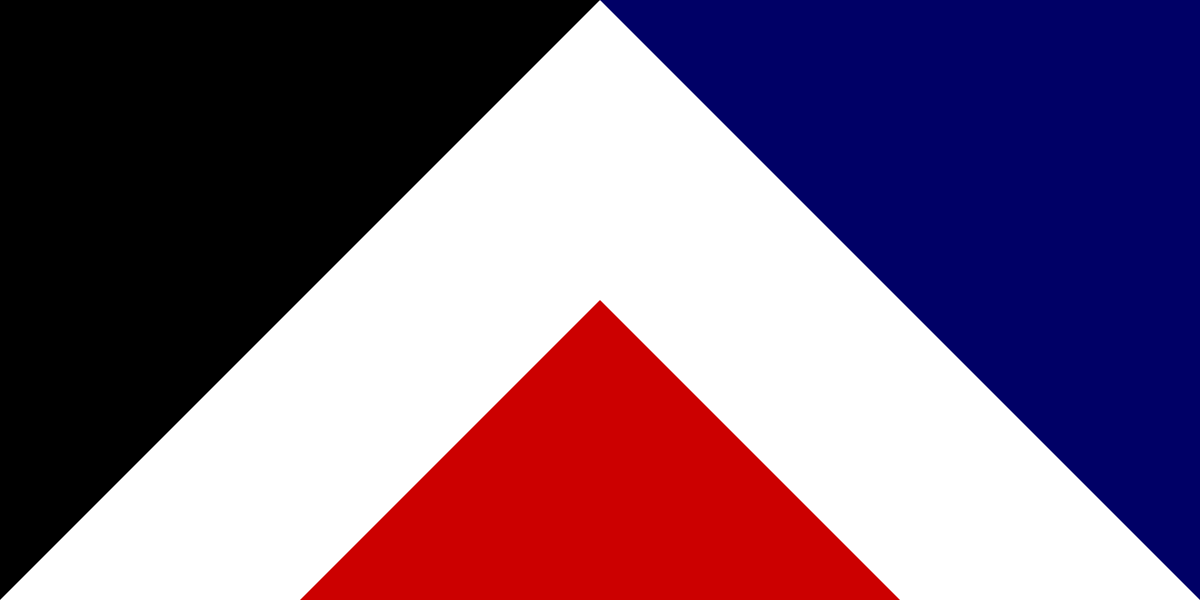
This design was supported by a vocal minority in the public but it bombed when presented in the referendum. Everyone agreed that while it’s simple and has good symbolism, it only makes sense after it’s explained. If you present it to people before you explain it, there is just no resonance. At first glance, the symbolism is actually as unrecognisable to us New Zealanders as it is to you Americans, so if you’re looking at this and you’re not sure what it’s supposed to mean, that’s exactly how we felt as well.
Deal-breaker 4: Designing for yourself

Some designers act like a flag is a personal art project and they don’t need the result to be in touch with general society. They express only their own preferences, appeal to only one sector of society, or just assume that everyone will feel the same way as them. Different themes, colours and symbols appeal to different people so it’s a mistake to focus on only on theme and exclude all other preferences, which makes the symbolism too narrow and is essentially self-sabotage.

This example contains green, inspired by nature, and the koru, a symbol from the indigenous Māori culture. The problem is that this appeals only to those who are both quite strong nature lovers and those who like Māori culture, while ignoring more common personas like those who prefer more familiar symbolism from the current flag or the silver fern. In real life, I’ve only ever seen this flag supported by the hippie types while everyone else thinks it just looks like a hippie’s personal art project.
Deal-breaker 5: Too radical

Some designers wipe the slate clean and deliberately aim for a revolutionary design with no familiar or established symbolism. They say “well, if we’re designing a new flag, then we’re designing a new flag, no need for weak-minded half-measures or sitting on the fence”. They don’t value familiarity and reject all previous flags and symbolism as irrelevant. They aim to prescribe a group’s identity rather than express it, which is the exact opposite of how a flag should work. Flags should have a wide appeal to the society it represents, so attempting something entirely radical excludes the people who prefer the familiar imagery that is already embedded in their collective unconscious, and this is also self-sabotage.

This example depicts matariki, which is a constellation that is important in the Māori culture. The problem is that the idea of matariki as a visual symbol is extremely obscure even amongst the Māori. I’ve personally never seen it on any logo or graphic, and I would say over ninety-five percent of the population would never even be able to recognise or draw this constellation if prompted. While the constellation itself obviously exists, the idea of using it as a national symbol does not exist, has no precedent and is essentially a complete invention that exists only in flag concepts like this, especially when all established visual symbolism in the current flag get thrown out the window in the process.
Deal-breaker 6: It’s boring, but it works
This is a really little-known deal-breaker because most guides to good flag design emphasise simplicity. While this is a key goal to aim for, a design that is too simple may alienate parts of the public who are expecting something more interesting. Flags should resonate with the public and that means they should be eye-catching, inspirational and memorable to everyone. A flag that feels too dull or weak to large parts of the public may become forgettable and lose support.

This example was proposed by a former prime minister. She said that if we want a flag that looks less colonial and more independent, we should just remove the Union Jack. The problem is, the result contains just the stars and a lot of empty space. While there are beloved flag designs that are just as plain and empty as this, many New Zealanders were expecting something more. They criticised this design as a super boring, watered-down compromise that nobody would ever feel proud to fly.
Redesigning the American flag badly (Illustrative examples)
I’ve illustrated the six deal-breakers with examples from the original context of New Zealand. Just for you all, I’ve artificially redesigned the American flag badly to illustrate these in a more familiar American context.
Illustrative example 1

So here’s the first example, and your thoughts are probably, “what am I looking at and what does this have to do with America”?
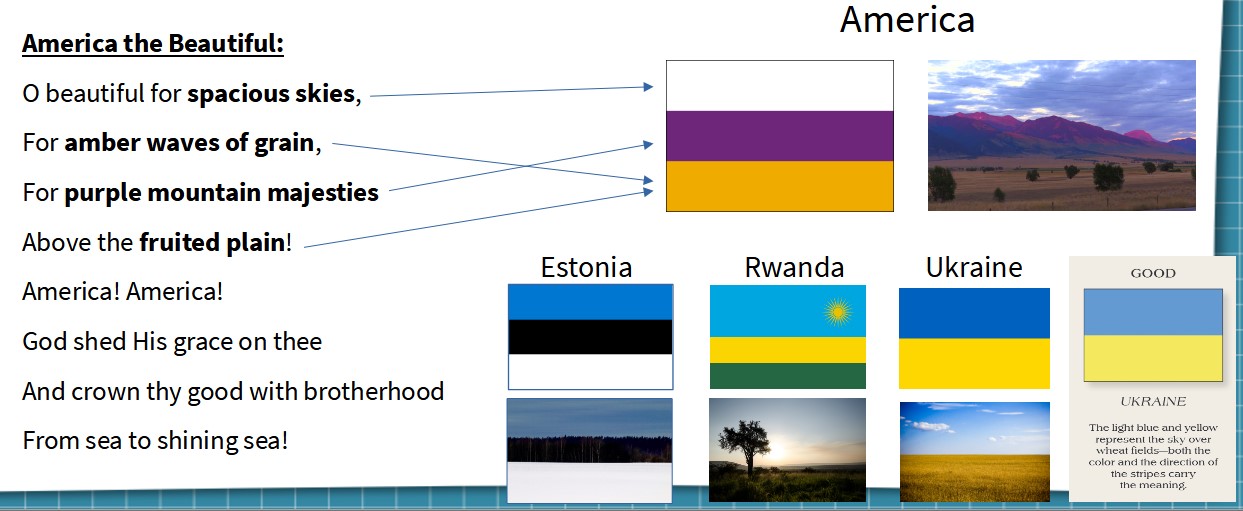
Well, this design is supposed to be based on the unofficial anthem America the Beautiful which describes some of its landscape – spacious skies, amber waves of grain, purple mountain majesties and fruited plain. It’s inspired by some other striped flags that represent the country’s landscape, like Estonia, Rwanda and Ukraine, which is actually featured as an example of a good flag in the Good Flag, Bad Flag guide for precisely this reason: “The light blue and yellow represent the sky over wheat fields – both the color and the direction of the stripes carry the meaning.” This is not to criticise Good Flag, Bad Flag, but rather to point out that a flag could be well designed from a technical point of view, but it could still be rejected by the public for other reasons.
Superficially, this design satisfies the five principles of good flag design:
- ✓ It’s simple.
- ✓ The symbolism has relevant meaning.
- ✓ It has only a few colours.
- ✓ It has no lettering or seals.
- ✓ The colour scheme makes it distinctive.
Technically speaking, there’s nothing wrong with the way it’s constructed. Yet this clearly would never be accepted by society, and we can look to the deal-breakers to explain why.
- ❌ Mystery symbolism —Until I explain what this flag represents, it’s totally incomprehensible and nobody would connect it to America.
- ❌ Designing for yourself – I designed this by choosing one theme and deliberately ignoring what anyone else thinks, as if a flag is a personal art project.
- ❌ Too radical —It contains absolutely no familiar or established visual iconography.
- ❌ It’s boring, but it works – Tricolour designs are too simple by today’s standards.
Illustrative example 2

Here’s the second example I made which is more straightforward. The symbolism is recognisable, but it also would never be accepted, and it demonstrates the other two deal-breakers:
- ❌ Looks like a logo, not a flag
- ❌ Looks like a souvenir, not a flag
Which are pretty self-explanatory in this case.

Just a side note, I designed this to be the direct American equivalent of the official New Zealand finalist flag which should give you a good idea of why it was poorly received by so many people and why the referendum failed.
Avoiding rejection and embarrassment: How to avoid the deal-breakers

Now that I’ve explained and illustrated the deal-breakers, I’ll explain how to avoid them. The main thing is to recognise how important they are – these are “deal-breakers” and not just “traps” or “pitfalls”. The public comments didn’t just treat these as minor problems, they completely dismissed designs with the deal-breakers.
You’ll want to avoid the deal-breakers if you’re designing a flag to make sure the design resonates with the public, or if you’re evaluating flags for a competition, to avoid any embarrassment if the public rejects the choices because of them. You can prevent them by aiming for the opposite and asking some rhetorical questions.

For “looks like a logo, not a flag” and “looks like a souvenir, not a flag”, try aiming for the opposite, “actually looks like a flag”. You can ask the question, “does it look good flying on a pole?” Most of us see flags as flat images on paper or screens, so imagining it actually flying helps to decide if it looks good as a flag and not just a flat graphic. Another question is, “if someone claimed that this flag was not a recent invention and was actually rediscovered in an archive from fifty years ago, would you believe it?” If the answer is no, that might be a warning sign that the style is too contemporary and flashy. If the answer is yes, it’s a good sign that it has a classic and timeless look.

For “mystery symbolism” and “too radical”, try aiming for the opposite, “intuitive, recognisable and familiar”. You can ask the question, “would a randomly selected member of the public be able to identify what the design is and what it represents without any explanation or context?” Obviously it’s not always possible for everything in a flag to be understood at first glance, but if there’s nothing to latch onto or it’s clear that the average person wouldn’t be able to even identify that a design is supposed to be a flag for their location, that’s a warning sign that it’s not intuitive.

For “designing for yourself”, try aiming for the opposite, “wide appeal”. You can ask, “are there any preferences in the public that we’re ignoring?” This forces you to stop using the aesthetic part of your brain and start using the sympathy part. You can think of some typical personas in society and what each one prefers. Obviously, it won’t be possible to please everybody and you shouldn’t aim for that, but if you at least consider the other personas, you can detect if a design is too single-minded and has only narrow appeal.
For “it’s boring, but it works”, try aiming for the opposite, “memorable”. Go back to the scenario where you ask if a random member of the public could identify the design, then ask, “if you got back to that person 24 hours later and told them it was a secret memory test, would they recall the design?” If the answer is no, that’s a warning sign that the design is too simple and boring to be remembered. This question is not just hypothetical as secret memory tests can actually be used during evaluation of flag designs and I’ve done this myself. This may not be a scientific process but it can still give some useful and surprising results.
Counter-example: Blue Sky flag
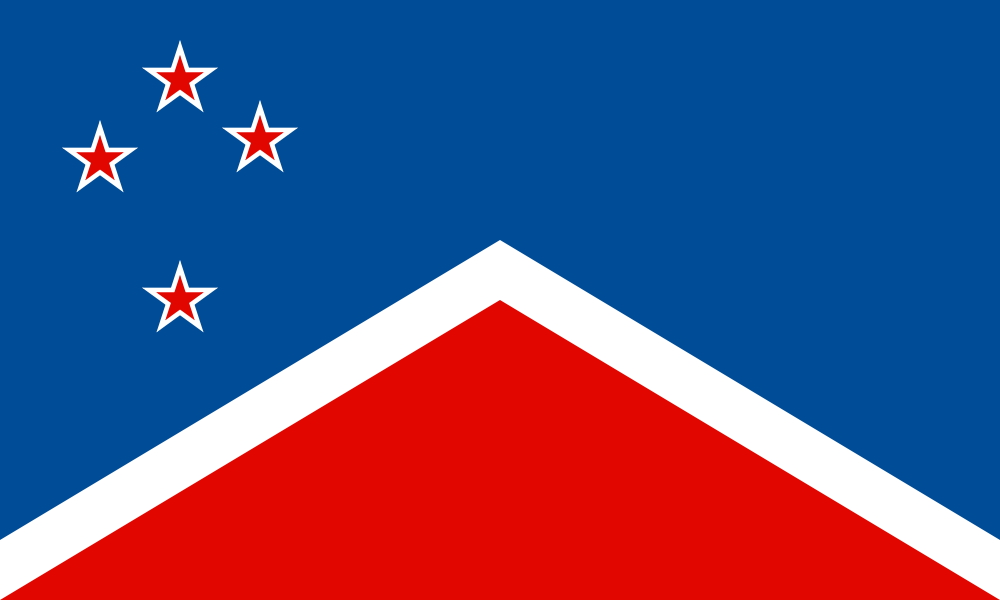
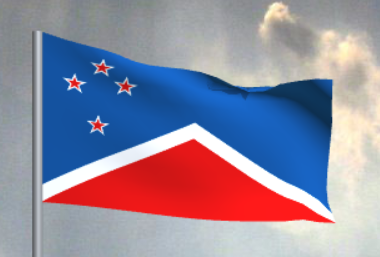
As a counter-example, James and I designed our own flag for New Zealand. Instead of designing a new flag for New Zealand, we aimed to design the new flag for New Zealand. We incorporated our analysis of public sentiment and aimed for the opposite of these deal-breakers, so we’re confident that this design passes all the tests that the other proposals failed and would have the highest chance of success.
- ✓ It satisfies NAVA’s five basic principles of good flag design but it goes well beyond these.
- ✓ It actually looks like a flag because we stuck to timeless and classic flag conventions so it doesn’t feel like a logo or souvenir.
- ✓ It’s intuitive, recognisable and familiar because it’s immediately obvious what it symbolises at first glance without explanation. The best symbolism is that which doesn’t need to be explained.
- ✓ It has wide appeal because it’s designed to ensure the highest possible public resonance based on our other statistical evidence of what symbolism resonates with the public, what divides the public and what the different preferences are. For statistically inclined people out there, we used a multiple linear regression model to maximise expected approval.
- ✓ It’s memorable because we actually did memory testing to evaluate our designs. This one stood out when people saw it and it stood out when they were secretly asked to recall it days later, so it strikes the perfect balance between simple and interesting.
Future work and questions
Reflecting on the analysis, there were some limitations and questions that suggest opportunities for future work.
- Were the original data representative of society? Although we took efforts to be comprehensive, there is a chance that we missed unpublished attitudes.
- Are there any other insights available from the comments? Unfortunately, we had limited capacity to keep the data, we were only interested in the final results and we never expected to revisit this again years later, so the original data would have to be scraped again.
- Are certain deal-breakers more important than others? Some appeared more commonly than others in the commentary, especially the “looks like a logo” deal-breakers, but this might say more about the designs than the public’s attitudes.
- Do these insights generalise across other societies? Anecdotal experience from other flag redesign efforts across the US and Britain suggest that these same themes are shared among other societies, but it would be good to confirm this empirically.
When is “next time”?
Redesigning a national flag is an exciting vexillological event, so many wondered if we’ll ever revisit this, and I’ll answer this with the latest poll from last year.
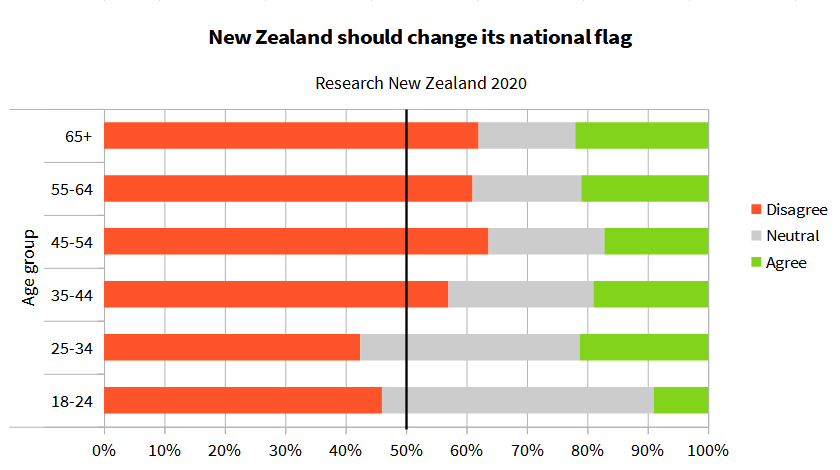
In the first graph, public support for flag change remains low, but the grey area for neutral responses gets wider for each younger generation, so the voting population will gradually become less committed as time goes on.

The second graph shows that changing from a monarchy to a republic is more popular and is already feasible. If that happens, the flag would be revisited as they are seen as related questions.
A useful precedent is Australia’s republic referendum in the late 90s. It pushed public support for changing their flag to skyrocket from a low 36% to a majority 52%, even though the referendum was unsuccessful and didn’t concern the flag itself. It probably would have gone even higher if the referendum was successful and this dynamic would also apply to us.
Putting the evidence all together, the flag question probably won’t be revisited by itself, but it would piggyback off a republic change when that happens in the future.
Conclusion
In conclusion, comprehensive analysis of the public comments around the New Zealand flag competition revealed six deal-breakers that can make or break a flag design in the public consciousness. Even if a flag is technically a good design, the public will still reject it if it looks like a logo or souvenir, if the symbolism is not recognisable, if the symbolism has narrow appeal, if it doesn’t contain enough familiarity or if it’s just too boring. We should recognise the importance of these deal-breakers and prevent them by aiming for their polar opposites and detecting them when they arise.
Ultimately, this is just the beginning. I hope this article will open up opportunities to investigate the “next level” of flag design beyond Good Flag, Bad Flag and to use qualitative research to gauge the public vexillological opinion in ways that would not have been possible before. More advanced techniques like data mining and sentiment analysis could be used to gain even more insights and further the field of vexillology.
Comments
After the Interest Area Meeting, there was some more questions and commentary from members about the silver fern, the American flag, the Laser Kiwi flag and comparing New Zealand’s flag change campaign to Australia’s. Secretary Ted Kaye mentioned that he recognised these deal-breakers from the dozens of American city flag design campaigns he has been involved with. He also talked about his experiences being interviewed as an expert during the New Zealand flag referendum. He mentioned the “bicycle race test”: When you are watching a bicycle race on TV and the participants are listed, the flag icons are tiny. Some flags like Japan and Canada instantly jump out in this list but New Zealand’s current flag takes some effort to distinguish.
Joe Gorman pitched in with this comparison: “Deal breaker #3 feels like it also applies to Halloween costumes: If they have to ask what you are dressed as, you have already lost.”
Here were the written comments from NAVA members about my presentation afterwards:
From Chris Sweet to Everyone: 07:52 AM
Excellent presentation – Should be published along with your script as a paper!
From Gary Flanders to Everyone: 07:53 AM
Excellent logic Brian, ‘Good on ya.’
From Tom Berryhill to Everyone: 07:53 AM
Great job!
From Ade DeRosier to Everyone: 07:53 AM
Thank you, nice job.
From Jon Meade to Everyone: 07:53 AM
Very good presentation! Thank you!
From Amber Atteberry to Everyone: 07:53 AM
Nice, thank you!
From Patrick Barritt to Everyone: 07:53 AM
Very interesting, thanks!
From John Andrews to Everyone: 07:53 AM
This was great. Good job, Brian!
From Jonathan Epstein to Everyone: 07:53 AM
Very interesting. Thanks!
From Graham Hodgson to Everyone: 07:53 AM
A great and very well thought out presentation!
From Randy Sabbagh to Everyone: 07:53 AM
excellent presentation!
From Phil Allen to Everyone: 07:53 AM
Great exposition! ..
From Steve Wheatley to Everyone: 07:53 AM
Thank you, Brian. A very cogent and thoughtful presentation.
From Raghavendra to Me: (Privately) 07:53 AM
Very Nice presentation
From Stan Contrades to Everyone: 07:54 AM
Agreed! Submit a copy for NAVA to publish!
From Graham Hodgson to Everyone: 07:54 AM
We need a “Good Flag, Bad Flag” sequel with these 6 points.
From Joshua Hodge to Everyone: 07:55 AM
Excellent presentation! New edition of GFBF with deal breakers. BTW, my favorite finalist was “Solidarity.”
From Terrell Jackson to Everyone: 07:56 AM
Excellent Presentation
The clarity on the mind frame when creating a flag was phenomenal. Amazing Presentation
From Graham Hodgson to Everyone: 07:56 AM
I like it

 Brian Cham's personal website